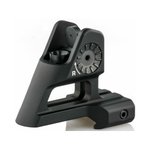
The rear sight works with the front sight to create a proper sight picture for aiming. Rear sights typically include windage and sometimes elevation adjustment for zeroing.
Rear Sight Types
Fixed: Always deployed, quick to use. Lower profile options available from Scalarworks and others.
Flip-Up: Most common BUIS type. Folds flat when not needed. Same-plane sights flip up to proper height.
Carry Handle: The original AR-15/M16 sight. Contains rear sight with windage and elevation adjustments. Detachable carry handles allow optic mounting while retaining iron sight capability.
Aperture Options
Dual Aperture: Two sight holes—large for close range/low light (0-200m) and small for precision/longer range (200m+). Most common configuration.
Single Aperture: One sight size. Some competition sights offer custom aperture sizes.
Aperture Size: Smaller = more precision, less light. Larger = faster acquisition, better low light. Match to your use case.
Adjustments
Windage: Horizontal adjustment to move point of impact left/right. All rear sights have this.
Elevation: Vertical adjustment for distance. Not all rear sights have this; some use front sight elevation adjustment instead.
Click Value: How much each click moves the point of impact. Common values are 1 MOA or 1/2 MOA per click.
Height Matching
Rear sights must match front sight height for proper zero. Standard heights:
- Same-plane: Both sights on rail height. Most common for BUIS behind optics.
- Fixed front sight base (FSB): Requires specific tall rear sight to match A2 height.
Co-Witness Options
When using BUIS with a red dot:
Absolute co-witness: Irons align in lower third of optic view. More cluttered but confirming.
Lower 1/3 co-witness: Irons below optic reticle. Cleaner optic picture.
Co-witness height depends on optic mount height and sight height. Many shooters prefer lower 1/3 for less visual clutter.
Selection Guidelines
Choose sights that match your front sight height and your intended use. For backup duty, quality flip-ups like Magpul MBUS Pro or Troy are proven. For primary irons, fixed sights offer faster deployment. Budget options work for range toys, but stake reliability on reputable brands for defensive rifles.
Always confirm your front/rear sight combination works together before zeroing.